Twentyfive years University cooperation materials science
The first fifteen years
Shortly after the 1972 Christmas bombing of Northern Vietnam, which caused immense sympathy for the Vietnamese people, many Dutch Universities offered cooperation to Institutions of Higher Education in Vietnam. The University of Amsterdam was one of the first. In January 1973 the University Council decided to offer a long term cooperation with the University of Hanoi.
In winter 1973 intensive discussions have taken place in the Ministry of Education and Training (MOET). The Minister Ta Quang Buu has proposed to ask the Dutch Universities to set up laboratories for Low Temperature Physics (Cryogenic Laboratory) and for Microelectronics, respectively, in the University of Hanoi (UH) and in the Hanoi University of Technology (HUT). He was convinced of the importance of fundamental research on Solid State Materials as well as on the applications of these materials in electronics in his country
It was well known in MOET, that the Netherlands with Kamerlingh Onnes had been the birthplace of Low Temperature Physics and Philips was considered to be one of the world leaders in Microelectronics. But there was also hesitation: what would be the reaction of the Dutch Universities, when asked for support in such advanced fields of science, while the war was still going on? Finally in June 1973 a positive reaction has been sent to the boards of the Dutch Universities.
In fact there was some doubt in the councils of the Kamerlingh Onnes Laboratory (University of Leiden) and of the Natuurkundig Laboratory (University of Amsterdam), that had been approached by the boards of their universities to execute the project “Cryogenic Laboratory”. However, the majorities of these councils voted in favour of the project and they got full financial support of the then left wing Dutch Minister of Development cooperation Jan Pronk. This was also the case with the project “Microelectronics”, executed by the University of Twente.
On April 31, 1975 the war was over and after some years of preparation the projects started effectively in 1977. In some years the basic infrastructure for research has been built up in both projects. 1979, when a second phase of the V(ietnam)- H(olland) University cooperation took off, was also the year some unforseen even in the world related with Vietnam. Questions in the Dutch parliament; new discussions in the councils of the involved departments in the Dutch universities followed. This time only the Natuurkundig Lab of Amsterdam University decided to continue whereas Twente and Leiden cancelled the cooperation. After elections for the Parliament in the eighties resulting in a more right wing Government only projects, formulated in 1979, with a “humanitarian impact” could survive. Amsterdam University, however, with own funds continued to support “its” projects in science. This year we could celebrate the 25th anniversary of the Cryogenic laboratory of the University of Hanoi.
New developments in the nineties
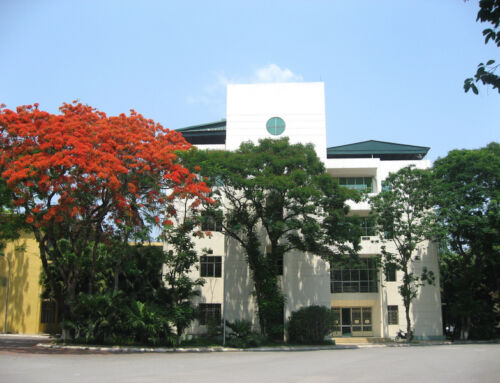
New elections brought Jan Pronk back as Minister of Development Cooperation in a new Government in the beginning of the nineties. In the Natuurkundig Laboratory. of Amsterdam University an initiative then has been developed to start together with the M(icro) E(lectronics) and S(emiconductor) A(pplication) Institute of Twente University a project on “Materials Science”. Representatives of these two institutions visited Hanoi in 1990, where, together with staff members of the Cryolab of UH and Technical Physics of HUT the new project “International Training Institute for Materials Science” has been formulated. It took more then a year to overcome objections in the Dutch Ministry of Foreign Affairs, but finally, with the help of Jan Pronk, approval was obtained in October 1992. On 17 December MOET on Vietnamese side also agreed with the project. This date now is considered as the starting date of ITIMS.
In this period the high education in Vietnam underwent a sudden mutation for the development. The number of students were 110.000 in 1987 and after 10 years (1997) if went up to 600.000. By this fax, the high education was faced the quanlity of education going down. The main season of it is the leak of the high quality teachers. The idea of MOET was to establishe the centers of excellent for training and scientific research. ITIMS would be the of these centers.
The activities of ITIMS
 The main intention of this project was to set up a two years Masters of Science (in Materials Science) program. In the last semester the students should take part in the research program of the Institute, parallel to (option) courses related to the subject of their MSc thesis. Moreover, (part of) the teaching staff for this MSc program should be educated during the planned three phases of the project: about 12 PhD’s who could run the MSc program on the long run. In fact, the project was stopped after two phases (in the of in 2000).
During the education of the “own” staff, the lectures of the MSc program had to be given by staff members from ITIMS network groups: teachers and researchers from the Cryolab. (UH) and “Technical Physics” (HUT) and from other departments of UH, HUT and the N(ational) C(enter) of S(cience) and T(echnology). They in turn could use research equipment of ITIMS. On Dutch side it was expected that such a network of groups would stimulate common research projects from departments from different institutions in a situation that most of them had rather poor research facilities.
The first version of ITIMS MSc teaching program, based on a MSc program in technical physics in Amsterdam University, has been regularly discussed and evaluated on meetings of ITIMS’ I(nternational) A(dvisory) B(oard). The IAB, with 7 scientists from the Netherlands, France, India, Sweden and the UK and 7 from Vietnam, adapted this program gradually to the needs of Vietnamese industries. However, a strong fundamental theoretical part was always kept in the program to enable the graduated MSc’s to develop themselves in new directions of applications.
Now after 10 years ITIMS we can state, that ITIMS has fulfilled most of its intentions with success:
– Until summer 2002, 9 MSc batches of ITIMS have successfully been graduated with 156 students. It is significant that more than 25 ITIMS’MSc graduated students have continued to study Ph.D. programmes in various fields in ITIMS and other research institutes and universities in Vietnam. Many others were automatically accepted for Ph.D. at foreign universities (26 in the Netherlands, 4 in France, 3 in Germany, 5 Japan, 4 Korea, 2 in US, 2 in Belgium). This is a good indication for the high quality level of training and education at ITIMS.
– The research activities of ITIMS are based on cooperation with the outstanding research group on Materials Science at the Hanoi National University, the Hanoi University of Technology and the National Center for Natural Science and Technology. These research groups (14 in total) form the Network group of ITIMS. Currently, with 38 scientific staff members, the main research of ITIMS are focused on the research directions: Biosensor and electrochemical sensors; Magnetic Materials and Applications; Optoelectronic and Photonic Materials; Micromachining Technology; High Tc-Superconducting; Bio-Composite Materials; Applied Informatics and Electronics. These research topics coincide with those in materials science and technology stimulated and sponsored by the Government, the Ministry of Education and Training through grants to scientific research programmes and projects as well as international cooperation projects with university and institutes in the Netherlands, France and Germany. In the last 5 years, hundreds of scientific articles have been published by ITIMS staff members, Ph.D. and MSc. students in various national and international scientific jounals and conference proceeding. In the 1995 and 1999, two International Workshops on Materials Science the IWOM’1995 and IWOM’1999 have been organised by the ITIMS with the contribution of more than 300 hundreds Vietnamese and about 100 foreign scientists from all around the would.
********
As preparing to usher in the 21st century, the ITIMS is committed to preserving the traditional that have sustained this great institution, while at the same time pursuing changes that will continue to instill in our graduates the vision and courage to face new challenges.
Amsterdam – Hanoi, November 2002
F.F. Bekker a and T.D. Hien b
a University of Amsterdam, The Netherlands
b ITIMS, Hanoi, Vietnam