The long way to ITIMS
(In March 1990 the Dutch minister for Development Cooperation, Jan Pronk, took the decision to enlarge the possibilities of universitary cooperation projects with Vietnam. Since 1983 only three projects received a modest amount of money from the Dutch government. Funding of other projects were stopped in that year.
The reason was that the Dutch government joined an international boycott of Vietnam because of the so-called “ violation of the Cambodian sovereignty by Vietnamese armed forces. In 1990 most troops were back in Vietnam. The cooperation could start again…
To understand the story one should know that the Dutch minister of Development Cooperation is working under the minister of Foreign Affairs. In case of political sensible questions, the minister of Foreign Affairs can overrule his colleague).
In the summer of 1990, I was invited to participate in a discussion at the ministry of Foreign Affairs in The Hague about new projects to be set up in Vietnam. Before the meeting I talked with Frans Bekker from the Laboratory of Physics of the University of Amsterdam. We decided that I would propose ‘ materials science’. One of the arguments to start with materials science was the existing cooperation between the University of Hanoi and the University of Amsterdam in that field. It was a cooperation which has continued on a small scale with own means by Amsterdam and Hanoi for about eight years. The representatives of the ministry accepted the idea and approval was given to ‘ identify’ a project on materials science. Frans Bekker and I went to Hanoi. The visit took place during the time when the first International Workshop on Materials Science was held, at the end of October and the beginning of November.
In some way it was a historical visit: it marked the end of a period of isolation. A few years earlier, the civil servant of the Dutch ministry of Foreign Affairs who was responsible for all universitary cooperation projects with developing countries, said to me: ‘ I am sorry, but for us Vietnam is a “white spot” on the map’….. From that moment on I called him “White Spot”.
In December, after we returned from Vietnam, I sent the proposal for materials science to the ministry, to the “White Spot”-civil servant who was still in power. In January and February I phoned White Spot a few times and asked whether he had read our proposal. He said he was very busy but promised to answer soon.
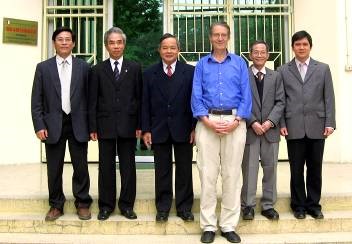
(Who is Peter?everyone knows)
At the beginning of March I could no longer stand this silence. I called to White Spot and asked him what was going on. He then told me that Foreign Affairs had objections. They believed that the project would strengthen the political position of the Vietnamese government. Moreover they felt a risk for military applications. White Spot lowered his voice: ‘ I can say you in confidence that we do not agree with that point of view, but Foreign Affairs has the last say in this case’.
‘What are you going to do?’ I asked him. ‘ You sent us to Hanoi, you even wrote an official letter to my university that the project idea was accepted’.
‘I am sorry’ said White Spot, ‘ but I cannot do anything’ .
During the next weeks, Frans and I phoned several times with the office of minister Pronk to get more information. Without success. The secretary of Pronk did not see any solution. But at the beginning of June it changed. The secretary let us know that a compromise had been made with Foreign Affairs: The leaders of the Universities of Amsterdam and Twente should go to Foreign Affairs to give arguments why the project would not lead to any military application and why the project will not strengthen the position of the Vietnamese government. After this discussion Foreign Affairs would agree with the project. This whole procedure would enable Foreign Affairs to approve the project without losing face.
In the early morning of June 17 two cars went to the Hague. One from Twente with prof Theo Popma, rector of the University of Twente and a second from Amsterdam with JanKarel Gevers, president of the Board of the University of Amsterdam, prof Jaap Franse and me. I still remember the mobile telephone between the two chairs in the front of our car. At that time a miracle of technology.
At the Ministry we were received by mr van Tooren, head of the Department of Asia and Oceania. He opened the meeting with an analysis of the political situation in South East Asia: ‘ Although Vietnam has withdrawn nearly all its troops from Cambodia, it still blocks free elections in that country. Under these circumstances we do not like to participate in structural assistance to Vietnam. This project is in our opinion an example of that kind of support. We think more about projects like environmental science or economy’. He explained: ‘these last projects would generate an impulse for political reform in Vietnam’.
I did not expected this blunt tone because we were told that the meeting would have merely a ceremonial character.
JanKarel Gevers knew the language which should be used in these circumstances and answered: ‘ I understand your point of view, but I can reassure you that universitary cooperation between the Netherlands and Vietnam always has been and will be a cooperation between scientists. Both governments have little to do with the cooperation. Besides, the dialogue between these scientists is much more interesting for both sides than the, in my opinion non-existing, strengthening of the Vietnamese government’.
After Gevers, Jaap Franse gave a short overview of the project and of the possible advantages for the society. As an example he mentioned that ‘ the development of new magnetic materials could lead in the future to efficient and cheaper generators. One should not exclude that this will result into more generators in the countryside and to electricity supply to areas, excluded from electricity until now’. Mr van Tooren nodded. ‘ I understand that you would like to say that the societal impact might be bigger than the exchange of ideas between economists or social scientists?’ Franse looked with a smile to van Tooren, and said: I can not overlook the importance of relations between those scientists, but I do know the potentials of materials science’.
The words of Franse remembered me to the years 1979-1982. At that time the ‘ low temperature physics’ project at Hanoi University was considered by the Dutch government as “ non-humanitarian”. And one of our argument against that opinion was also the ‘ electrification of the rural areas’.
Van Tooren continued: ‘ Another serious problem is that the project might generate military applications’. Now Theo Popma took the floor: ‘ I am rector of a Technical University. Our main concern is technological applications. I can tell you that it is a very long road to come from research to a first prototype and from a prototype to production. This project still should start. I do not think that production-ready applications are possible within thirty years’.
Nobody said something about the contradiction between the remarks of Franse and Popma. While Franse believed that useful applications could be expected, Popma was speaking about the very, very far future.
It seems to me that Franse understood it and would avoid possible remarks because he came up with a new issue: ‘ An international Advisory Board will be formed. This Board will follow the main lines of education and research. Each year a meeting is planned during which the results and planning will be evaluated. Members of the Board are scientists from the Netherlands, France, England, USA, Sweden. The Board can advise the institute at any time it thinks that is appropriate’.
The meeting ended with the promise of van Tooren said that he would take our arguments into account and would let us know the final decision.
For me it was a strange meeting, but I thought that it was part of a game we had agreed upon earlier.
At the end of July, more than one month after the meeting, I phoned with the office of Pronk to ask whether a final decision about materials science had been taken. The lady I got at the line did not knew about it, but she remembered that a few days ago minister Pronk had sent a letter to his colleague Tran Hong Quan. I asked whether she could say something about the contents, but that was not possible she said.
I phoned straight away to Vo The Luc, working at the department of International Relations of the Ministry of Education and Training. I knew Luc already for many years. I asked him whether he had seen the letter. ‘ Yes’ said Luc, ‘I just got it from prof Quan. He would like to get my advise what we should answer’. He continued: ‘ It is a positive letter, I like to hear your opinion. I will put it on the fax for you’.
A few minutes later I had the letter in my hands. It was an answer on a earlier letter of Quan of half a year ago in which he proposed seven new projects. I knew that letter: Quan had given to ‘materials science’ the highest priority.
On the first page I read that Pronk agreedto finance five projects, that was indeed positive. But the bad news came on the second page. One project with the title: ‘introduction of new education methodologies’ was refused. Pronk wrote: “the introduction of new methodologies in higher education is a field which I regard as less important in the context of cooperation between Dutch and Vietnamese universities”. I could not understand how he came up with that idea. Education in Vietnam at that moment was in my eyes mainly a process where a teacher read his own lecture note in front of a class of students. The students wrote it down and learned the text afterwards by heart.
But the very last sentence of the letter materials science was for me a shock: “ the possibility of undertaking some form of cooperation in the field of materials science is a matter on which a decision is still pending”. I felt betrayed. What had been the sense of our meeting in June? All efforts for nothing?
I phoned again with Luc. Indeed, he had noticed the sentence about materials science, but still considered the letter as positive. ‘ We got five projects out of seven, and materials science still unclear’. Perhaps I made some angry noises, because Luc said: ‘ Is it not dangerous for the other five projects to continue to press on materials science? Perhaps by doing so we lose these projects?’ I did not see that risk. I still could not believe that our visit to the Hague was for nothing. I said to Luc: I will try to find out why the letter has been written in this way’. ‘ OK’, Luc said, ‘ we will not answer to Pronk. I will wait on your information’.
The following weeks I tried in vain to get contact with Pronk. Anyhow, it was clear that the struggle inside the ministry of Foreign Affairs was not yet over.
But on September 19, Pronk let us know that Foreign Affairs had decided, as he formulated it, “not to stop the project any longer”.
The next morning I called White Spot and asked him when we could go to Hanoi for the final formulation of the project. He told me that we should wait on the “Identification Memorandum”. In civil-servants-language abbreviated till “ IDMO”. I did not knew what a IDMO was, I thought a formality, just some lines on a sheet. But White Spot explained me that an IDMO is a judgment about a project. Each project to be carried out in an developing country should be examined by the local embassy whether it is relevant for that country, in this case Vietnam. It was the task of the Dutch embassy in Bankok to write the IDMO, because the embassy in Hanoi was closed some years earlier. The embassy would check the project again on its usefulness for the society, even after all the discussions in the Netherlands.
Again problems, I feared. And that was right. Some people at the embassy, who did not like the project, succeeded to delay the writing of the IDMO for six months.
In April 1992 Theo Popma, Frans Bekker finally were allowed to visit Hanoi to elaborate the proposal. But the ministry of Foreign Affairs has a new condition:, probably initiated by the embassy in Bangkok: the project should have a clear ‘spin-off’ : The applied research should lead, with a great probability, to the set up of small industries . To check whether this condition could be fulfilled, White Spot has contracted an economist to join us. He was asked to write a report about the possible ‘ off-spin’. The project would only be approved when his report was positive.
Even after so many discussions in the Netherlands, it seemed suddenly be forgotten that applications were only likely in a very far future. And that the chance on the establishment of small industries, using the technology from ITIMS, was nearly zero within the next period of ten years. Furthermore, Foreign Affairs asked an economist who has no knowledge about the technology of ITIMS to make a report about the “spin-off” of ITIMS. This man understood what he had to do, to write a positive report. And he did it. White Spot got his report and we our project….
Hanoi December 2007
Author: Peter de Goeje