Establishment of the HUT-Rits MEMS R&D Center
The HUT-Rits MEMS R&D Center has been the fruition of an application that Ritsumeikan University (Rits) and Hanoi University of Technology (HUT) submitted in May 2005 to NEDO (New Energy and Industrial Technology Development Organization, Japan) for the project “Establishment of MEMS R&D Center for Catalysis of Advanced Industrial Technology in Vietnam”. The duration was 2 years (2005-2006). The grant award of total was 90,000,000 JPY. The purposes of the project were (1) set up fundamental fabrication facilities for MEMS at ITIMS, (2) educate researchers and staff, so as to achieve MEMS R&D capability in Vietnam, (3) develop new MEMS sensors to be designed, produced, tested, and used in Vietnam. The aim of the establishment is that unlike LSI technology, which is now technologically mature and difficult to penetrate, MEMS is still in rapid development, and is only now passing from research to industrial applications. This provides a window of opportunity for Vietnam to gain a share of this important field, thus contributing to the industrial and economic development of the country.
Let me thank with respect the leader of the Vietnamese side, Prof. Ha Duyen Tu, Vice Rector of HUT, for graciously agreeing to join this project. Director of ITIMS, Prof. Than Duc Hien, Director of Research Center for Automation, Prof. Nguyen Thien Phuc, and Vice-director of the Department of International Relations, Prof. Ta Phuong Hoa, for their role in developing and finalizing the project plan and effort to success the project. Also, I thank Dr. Dao Viet Dzung of Rits for his tireless contributions to planning and executing this project, and for coordinating the both side.

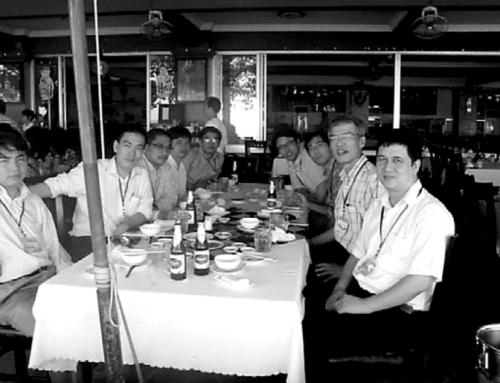
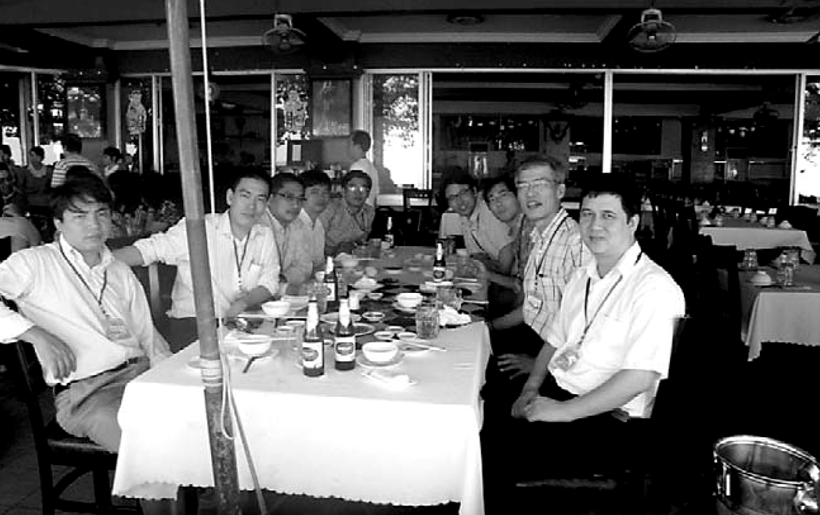
Professor (2nd from left) to the visit of HUT, 2006
MEMS (Micro Electro Mechanical Systems) are micro integrated devices that are fabricated by micromachining processes based on semiconductor, LSI technology. Contrary to LSI systems, which are static, MEMS can move and deform. MEMS are able to process not only electrical information but also physical, chemical, and biological information, as the system’s input and output. As LSI technology has matured, the focus of industrial R&D worldwide has shifted to the far possibilities and varieties afforded by MEMS technology.
As the 21st century starts, numerous MEMS devices and products are emerging from laboratories, and the era of finding “what to make” has arrived. MEMS are also becoming important as the tools for research in nanotechnology, and as the platforms that will allow nanotechnology to be developed for practical use. As the essential elements in advanced industrial products, MEMS are expected to broadly impact our lives in the near future.
Thus, MEMS presents exciting hopes and challenges. Through this project we hope that Japan and Vietnam can develop a fruitful partnership to benefit together from the coming explosion of MEMS industry. Obviously, success is not guaranteed; for the success of this project, the sustained and coordinated efforts of young researchers on the Japanese and Vietnamese sides will be essential. Through this project, I deeply hope to see a blossoming of understanding and friendship between our two countries, and thereby a real contribution to world peace.
Kyoto November 2007
Author: Prof. Susumu Sugiyama;
Director, Research Institute for Nanomachine System Technology
Ritsumeikan University, Japan