Academic-Industrial Cluster on Micro-Nano System Technology
The year 2006 marks several important events for Vietnam: the world’s second-fastest growing economy with annual GDP growth rate of more than 7% from 1990 to 2006, being official member of WTO. Recently, it successfully hosted the APEC Economic Leaders’ summit. Directly or indirectly, these lead to a big jump in Foreign Direct Investment (FDI) inflow which has reached over US$8.27 billion this year, up by 47.4% year on year. In particular, the investment for high-tech projects has been substantially increased up to US$3.5 billion from previous US$2.6 billion. As an example, the global leading chipmaker, Intel, has just obtained a license to invest US$1 billion in its chip development center in Vietnam. Confronting with these opportunity and challenging, Vietnamese government has affirmed that science and technology (S&T) is the top priority not only for speeding up the country’s industrialization and modernization process but also for maintaining its competitiveness in the global economic community.
Micro-nano system technology (MNST) has received increasing incentive from the government in its high-tech development agenda. The total grant for R&D in MNST increases from US$ 0.35 million in 2003 to nearly US$ 10 million in 2006. Several MNST laboratories have been funded and established. For example, a budget of about US$3.5 million has just been allocated to the Laboratory of Nanotechnology in the Vietnam National University in HCM City (VNUHCMC). Another budget of about US$2.5 million has been granted to establish a laboratory of Micro and Nano-Fabrication in College of Technology, Vietnam National University in Hanoi (VNUHN) during 2006-2008 periods. The Institute of Material Science (Vietnamese Academy of Science and Technology) also received a multi-million US dollar grant for establishment of new research center on nanotechnology. Over the past two years from 2005, our MNST research group at Ritsumeikan University has been working on transferring MNST to Hanoi University of Technology (HUT). We have established the first MEMS R&D research facility in Vietnam through the financial support of nearly US$1 million from NEDO Japan. This project also aims at educate and train faculty members and students of HUT and other research institutes to develop MNST-based devices.
Based on our observation, although R&D in MNST has been very active in academia, transfer of intellectual properties (IP) from research laboratories to commercialization in industry is inefficient. This shortcoming stems from the fact that most of those R&D centers are operating independently from industry. Moreover, there is a huge gap between the research interests of academia and manufacturing demands of industry. Consequently, research results in laboratories are slow to reach industry and the practice. Motivated by those facts, we propose to:
Create an academic-industrial R&D cluster on MNST, whose members are top universities in Vietnam, i.e. HUT, VNUHN, VNUHCM and Vietnamese and Japanese companies, to exchange information and know-how. The members of this cluster will be provided with up-to-date information from academia and industry about MNST through seminars, lectures given by internationally well-known professors and scientists who are prominent in this field from Japan.
Promote collaboration between academia and industry inside the established cluster to convey research results from laboratories to the market place and, on the other hand, provide feedback from industries to R&D centers to make the research in those centers highly-suitable for industrial needs.
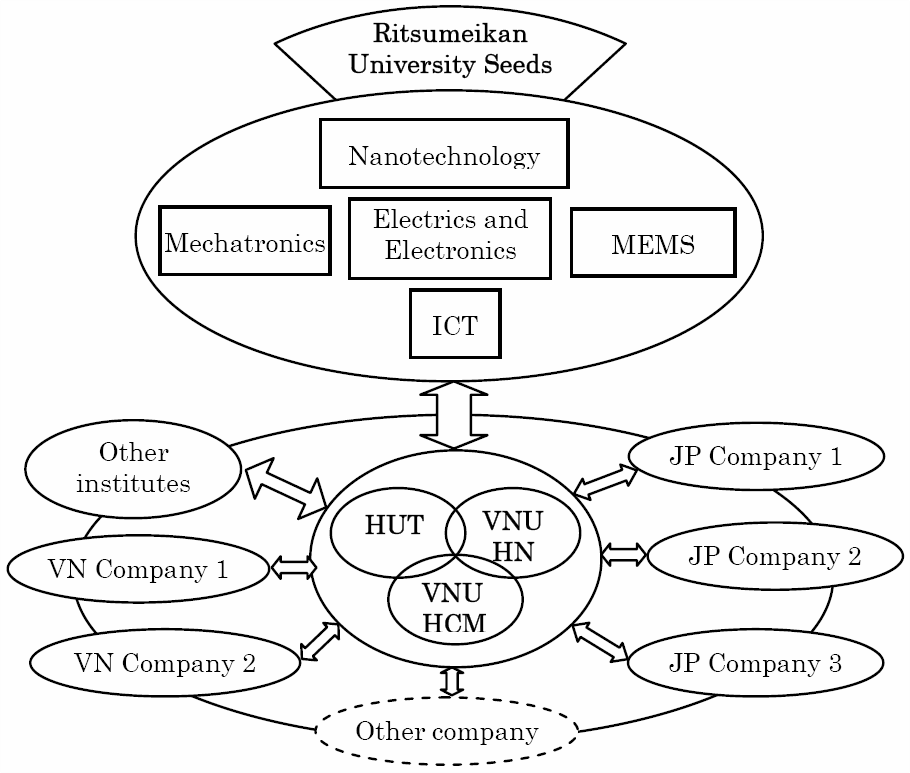
One of the models of the academic-industrial R&D cluster on MNST is depicted in above figure. The main objective is to establish a bridge between academia and industry that will bring MNST knowledge and know-how from laboratories to industry, and seed potential commercialization possibilities. The expected results will be an academic-industrial cluster on MNST, whose core members are the top universities in Vietnam, e.g. HUT, VNUHN, VNUHCM and several Vietnamese & foreign (e.g. Japanese) companies in Vietnam involving in mechatronic to exchange information and know-how. This academic-industrial R&D cluster will get the technological seeds from well-known universities those have been cooperating with Vietnamese academia in both technological and financial aspects.
For example, in Fig. 1, Ritsumeikan University is selected to provide technological seeds to the cluster, because this university is well-recognized in Japan for its Government- Industry-Academia relation model. The experience from this model will be of much value to successfully create the cluster.
Thanks to Ritsumeikan’s NEDO project, we have effectively implemented technology transfer, education and training of MNST R&D in the top technological universities in Vietnam, e.g. HUT, VNUHN and VNUHCMC over the past two years from 2005 to expose the researchers to fundamentals and up-to-date information about MNST by internationally well-known professors in this field from Japan. The companies interested in MNST will be invited to such kind of seminars and become members of the cluster. The size of the cluster can be expended year by year with new members are admitted. Knowledge and up-to-date information on MNST will be provided for researchers in the seminars in the forms of books, scientific journals and lecture notes.
As for conclusion, once such an academic-industrial R&D cluster is created, it will strongly promote the collaboration between academia and industry to convey MNST research results from academic laboratories to industry and, on the other hand, provide feedback from industries to R&D centers to make the research in those centers market-oriented. Furthermore, the company members will have access to research facilities inside universities and to approach the intellectual properties, i.e. patents, more efficiently.
Author: Dao Viet Dzung and Susumu Sugiyama
Ritsumeikan University